A WRITING PIPELINE FOR CODING AGENTS · v0.7

Velith

Books to the human-quality bar.

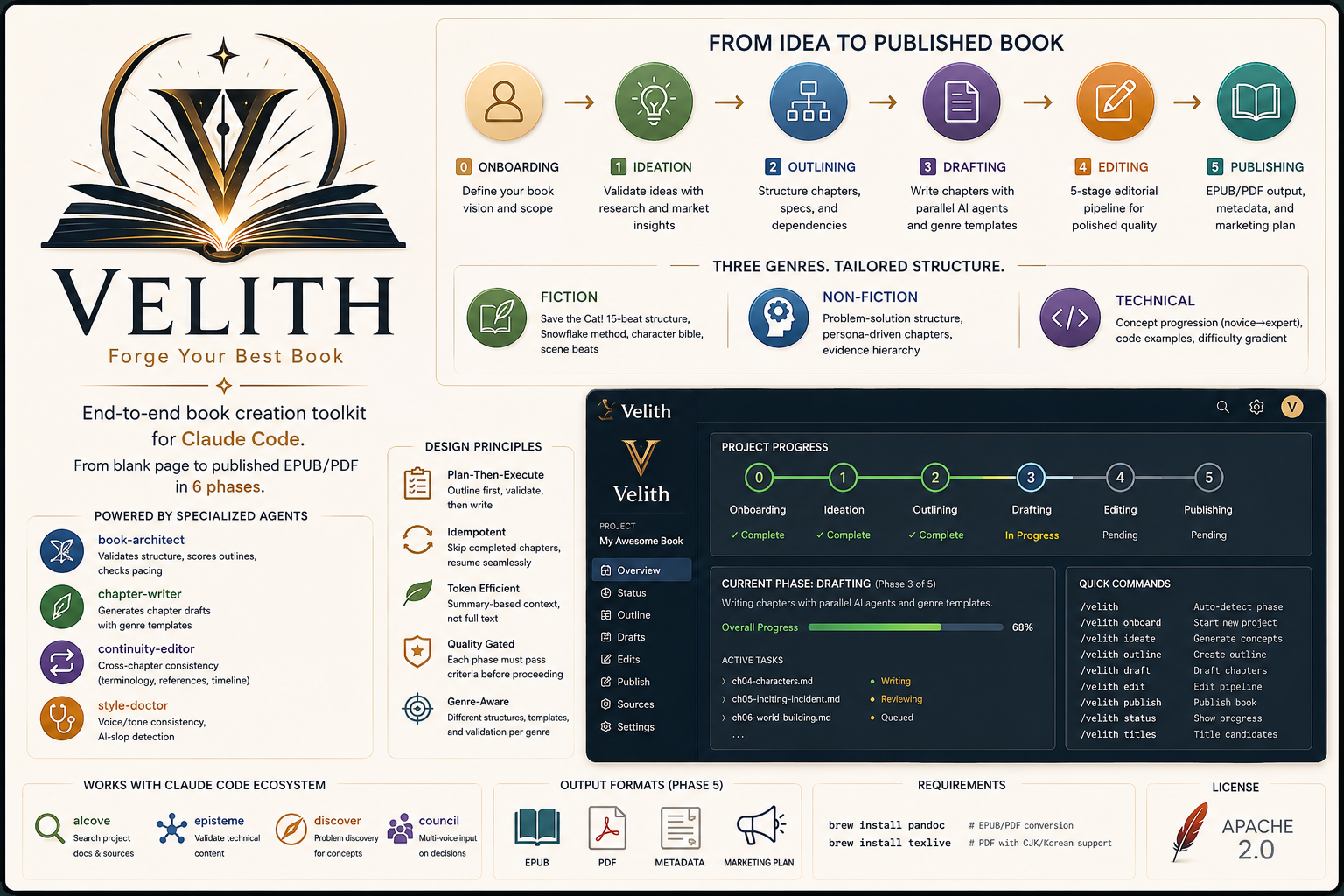
Six phases take a book from a blank page to a publishable EPUB — and hold every chapter, every edit, and every image to one standard: a cold reader who buys books in this genre cannot tell it was machine-drafted.

Claude Code · Codex CLI · Grok Build · Agy · Cursor · Cline · Aider

The method

A pipeline, not a prompt.

Frontier models write good sentences. Left alone they still write books readers put down. None of that is a model problem — it is a pipeline problem — and Velith is the pipeline.

Diagram of the Velith feature system

Why books fail

What readers actually notice.

Velith’s quality bar is built on the 2026 AI-tell taxonomy — the things that put readers down now, not the “delve” lists of two years ago.

Agents receive chapter summaries.
Every agent reads the entire manuscript. Frontier models carry a million tokens; a novel is under 200K. Summaries are what made the voice drift.
One pass per chapter, saved as-is.
Draft → cold critique with quoted lines → revise — before the file is ever saved.
Editing produces reports.
Editing rewrites the manuscript in place, with snapshots, across seven stages.
“Files exist” counts as done.
Publishing is gated by simulated readers: three target readers and one genre professional cold-read the book. Every axis ≥ 7, no put-down point in the first three chapters — or the verdict is REVISE.

The gate

Five axes. Scored honestly. Published only above the line.

The same rubric every writing, editing, and reviewing agent reads. Voice lock needs axis one at 7 or better. Publication needs all five.

Dramatis personae

Twelve specialists, one shared standard.

Skills are the entry points; these are the agents behind them. Each has a minimal toolset and its own effort level — the writer and the beta reader get the most.

book-architectChooses and justifies the structure, scores the outline, proposes restructures.
scene-generatorPlans every fiction scene — purpose, turn, subtext, exit hook. Plans, never prose.
chapter-writerDrafts one chapter in full context; critiques itself with quoted lines; revises.
continuity-editorHunts contradictions and repetitions across the whole manuscript against the bible.
fact-checkerBuilds a claim ledger; verifies against sources and the web; removes what it can’t verify.
style-doctorMeasures rhythm, tells, and drift with real metrics — then rewrites in place.
beta-readerCold-reads as three target readers and one professional; issues the verdict.
art-directorOwns the one look per book: art bible, look lock, vision QA on every image.
figure-engineerRenders diagrams, charts, and drawings from code — labels verified against the text.
illustratorIllustrations from compiled art-bible prompts, for whichever image model you have.
cover-designerCover concepts from the art bible — ebook, print wrap, audiobook, marketing.
marketing-expertPositioning, comparable-title framing, channels, and the launch calendar.

Usage

Two commands start the book. /loom runs the rest.

You approve at the author checkpoints — concept, outline, voice lock, look lock, readiness. Everything between them runs unattended.

In Claude Code

/plugin marketplace add epicsagas/plugins
/plugin install velith@epicsagas
# in your empty book directory
> /book-init   # genre, reader, voice sample → PRD + STYLE
> /loom        # detects state, runs the next phase, stops at checkpoints

Eighteen skills ship with the plugin, including seven genre craft references — fiction, non-fiction, technical, screenplay, poetry, game, academic — and a custom genre builder.

On the command line

node velith.mjs scan my-book --ui
node velith.mjs metrics drafts/ch07.md
node velith.mjs snapshot my-book pre-lineedit
node velith.mjs images compile my-book
node velith.mjs images render my-book

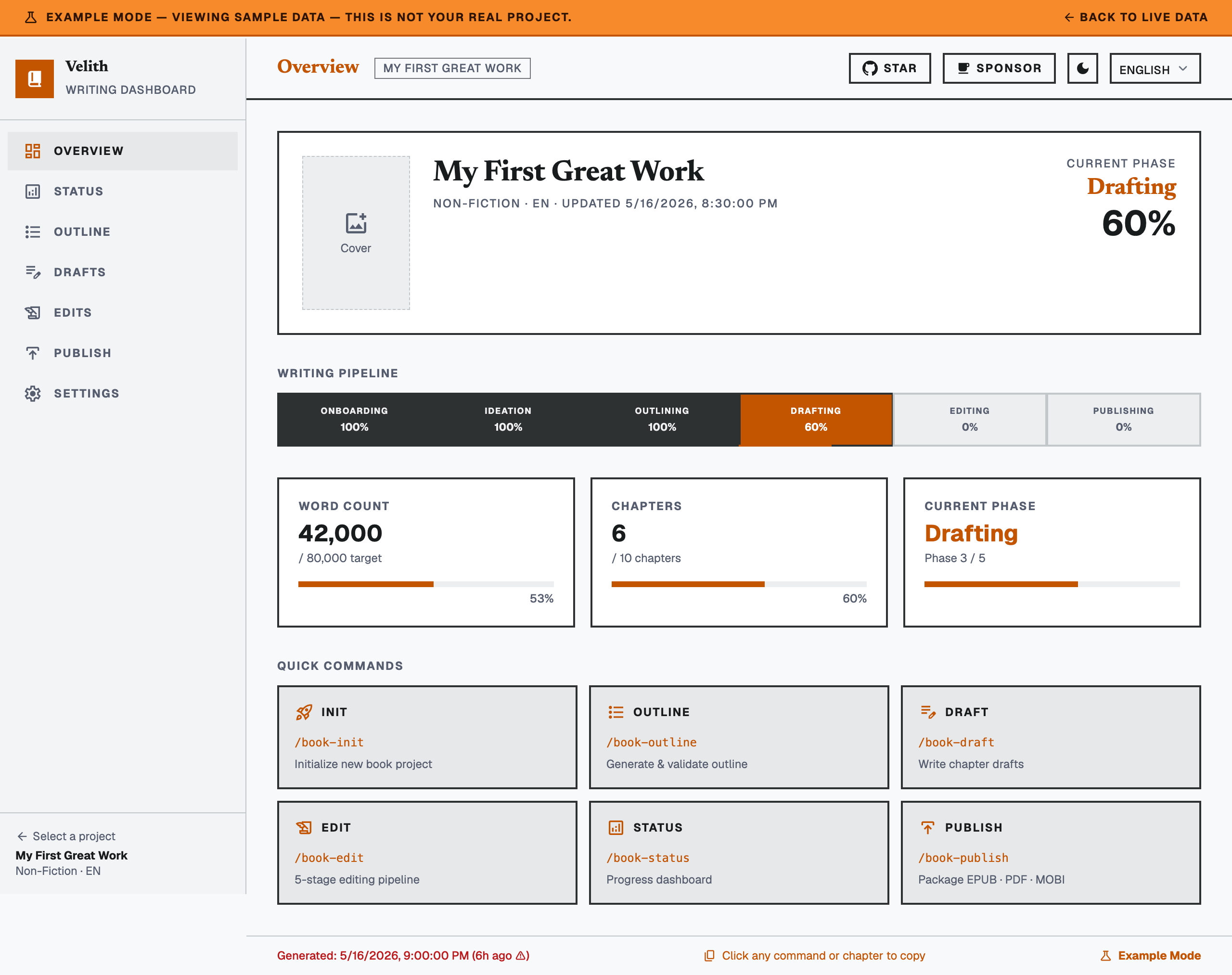
Deterministic prose metrics (sentence rhythm, tell density, cross-chapter repetition), snapshots before every rewriting stage, and per-backend image prompts. /book-status --ui opens the Svelte dashboard.

The Velith dashboard: pipeline tracker, agent cards, chapter table, editing stages, readiness verdict

Compared

Against the alternatives.

VelithRaw promptsNotion AIJasper / SudowriteScrivener
Full-manuscript contextEvery agent, every taskManualNoneLimitedn/a
Voice lock + critique loopBuilt inNoneNoneNoneManual
Fact-checking, claim ledgerDedicated agentNoneNoneNoneManual
Readiness gate by cold readersBlocks publishingNoneNoneNoneNone
Visual consistency per bookArt bible + vision QAPer-image promptsNoneNoneNone
OutputEPUB, PDF, MOBI, TXT, MDCopy-pasteMarkdown / PDFDOCX, limitedDOCX, PDF
ControlPrompt-level, Apache-2.0FullBlack boxBlack boxFull

The reader never has to know. The writer always does.

Start with onboarding and a page of your own prose — the voice fingerprint does the rest.